
 EN


In the first half of 2026, six publicly listed freshly-made tea companies generated a combined revenue of approximately RMB 36.78 billion, representing a YOY growth of roughly 9.0%; their combined net profit attributable to parent company shareholders stood at around RMB 5.34 billion, reflecting a YOY decline of approximately 2%. Signals of market slowdown have become clear compared to its previous hyper-expansion phase when growth exceeded 20%.
*Data source:China News Service, September 2026
Industry growth rate in 2025, dropping sharply from 2023 (19.3%)
Nationwide freshly-made tea brands store count change in the past year, with more than 110,000 stores shuttered
Number of stores closed across 112 freshly-made tea chains in H1 2026, with over 60% of brands scaling back
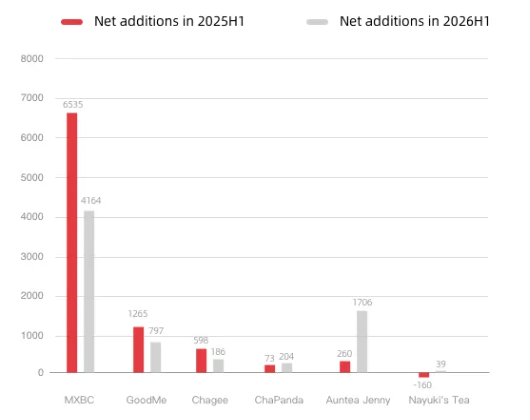
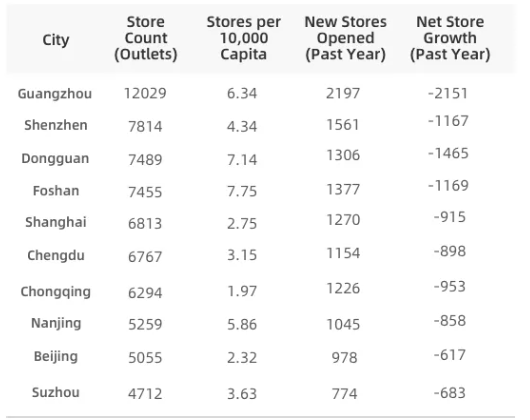
In terms of expansion pace, several listed freshly-made tea enterprises have noticeably shifted down gears. Store network growth for MXBC, GoodMe, and Chagee has slowed significantly, with net store additions decreasing by 36.3%, 37.0%, and 68.9% respectively. Among the top 10 cities with the highest concentration of tea drink outlets, every single market experienced net-negative store growth over the past year.
Comparison of Net Store Additions Among Six Listed Freshly-Made Tea Enterprises in H1 2026
*Data Source:https://www.toutiao.com/article/7683110276111122996/?&source=m_redirect
Top 10 Cities by Milk Tea Store Count
*Data Source:CanYan (Zhaomen), as of July 13, 2026; cited via KaaMen https://ad.36kr.com/p/3924481272576387
Squeezed by Price wars, Homogenization, and Prudent consumption, the sector shifts from shared expansion to zero-sum competition
→Three key drivers behind the market cool-down
Price wars eroding profit margin
The price of a cup of milk tea has plummeted from RMB 30 to RMB 9.9 amidst fierce competition; HEYTEA introduced as low as RMB 9, while Nayuki rolled out its "Relax Series" priced RMB 9 - RMB 19. In the first half of 2026, Nayuki's average order value at self-operated stores dropped to RMB 24.3, marking a 5.44% YOY decline. (Data Source: Nayuki's Tea H1 2026 Interim Financial Report)
Industry observations reveal that price reductions do not necessarily drive order volume growth; instead, price undercutting continues to squeeze the margins of freshly-made tea brands.
Intensified product homogenization
The lifecycle of viral hit items continues to contract, with ingredients, flavor profiles, and packaging increasingly converging. The conventional formula of "new product launches + marketing + aggressive store openings" requires ever-greater resources to sustain, making product differentiation increasingly challenging.
Return to rational and value-conscious spending
Young consumers are embracing a consumer mindset of "securing essentials first, optimizing discretionary spend selectively“, tend to allocate limited budgets to high-value purchases. As a non-essential consumer good, freshly-made tea has borne the brunt of this shift.

*Image Source: Generated by Doubao AI
→ Strategic pathways forward
Brands like GoodMe and Auntea Jenny build competitive advantages by penetrating lower-tier markets and leveraging direct farm-to-store supply chains.
Expand product portfolios into coffee, desserts, and alcoholic beverages.
MXBC spans operations across 17 countries with around 64,000 stores; Chagee is aggressively accelerating its international footprint.